

Towing tyre pressures guide
Tyre pressures are important but even more so when you are towing. Both the tow vehicle and the trailer, camper trailer or caravan you are towing need to have their tyre pressures set correctly. If your tyres are underinflated it can lead to excessive wear, flexing and overheating.
In order to calculate correct tyre pressures you need some information from the side wall of your tyres, your vehicle and trailer/caravan weights and a formula.
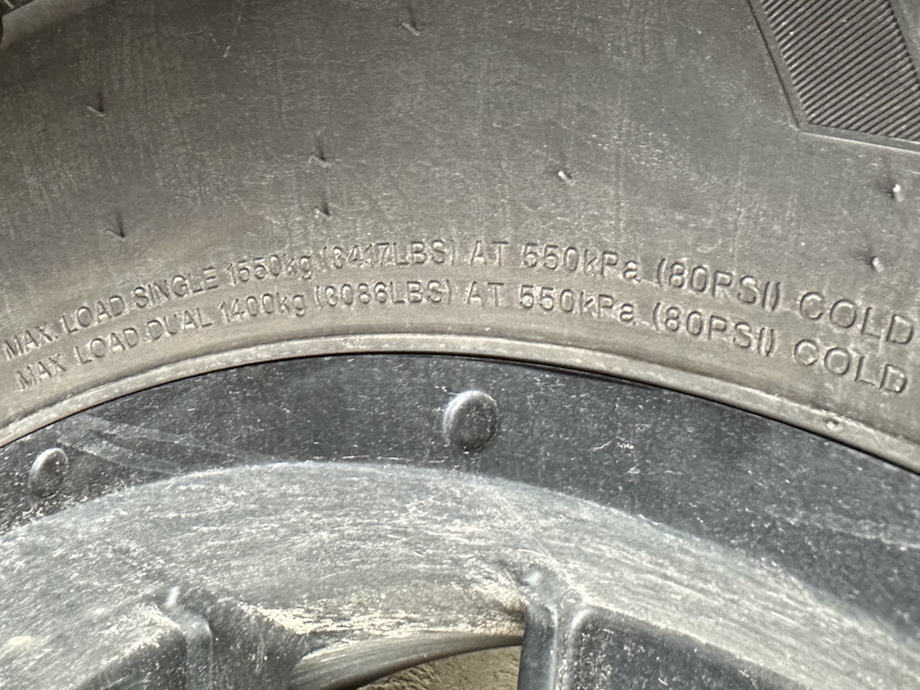
The 2 key items from the tyre side wall are: maximum PSI and maximum load for the tyre. If there is no maximum load you can identify the tyre load rating and use a tyre load rating scale to identify the maximum load.
Caravan Calculation
If we run through an example of a single axle caravan with a weight across the axle group of 2750 kg. The side wall shows max PSI of 80 and max load for a single axle van of 1550 kg. Since this is for one tyre and the single axle has 2 tyres, the axle group load needs to be halved to get the load per tyre. So for this example we have 2750 kg / 2 = 1375 kg per tyre.
Now comes the formula and the math.
Recommended tyre pressure = (max PSI / max load) x current load.
We have (80 PSI / 1550 kg) = 0.05161 as the tyre PSI factor
Then we have 0.05161 x 1375 = 70.96 or 71 PSI recommended tyre pressure
If we have a dual axle caravan with the same tyres the max PSI is the same but the max load is reduced to 1400 kg as per the sidewall info. The current weight on the axles (GTM) of 3081 kg. We need to keep in mind that this is across 4 tyres so it’ll be 770 kg load per tyre.
So back to the math.
We have (80 PSI / 1400 kg) = 0.05714
Then we have 0.05714 x 770 = 44 PSI recommended tyre pressure
Tow Vehicle Calculation
When you look at the tyre pressures of the tow vehicle you also need to gather the side wall info as well as know the weights on your front and rear axles. When you hitch a caravan keep in mind that the tow ball mass (TBM) is typically behind the rear axle so the rear axle acts like a seasaw with the rear of the vehicle sinking and the front of the vehicle rising when hitching the trailer/caravan. The weight lifts off the front axle and is transferred to the rear axle.
As an example a dual axle caravan with a tow ball mass (TBM) of 267 kg but the difference in the rear axle weights from unhitched to hitched is 315 kg on the rear axle. With this additional 315 kg on the rear tyres they will need more air in the tyres and with the front tyres having less weight will need to have some air taken out to be at the correct pressure.
If we take the following info and do the math for the tow vehicle we will see the difference when hitched and unhitched.
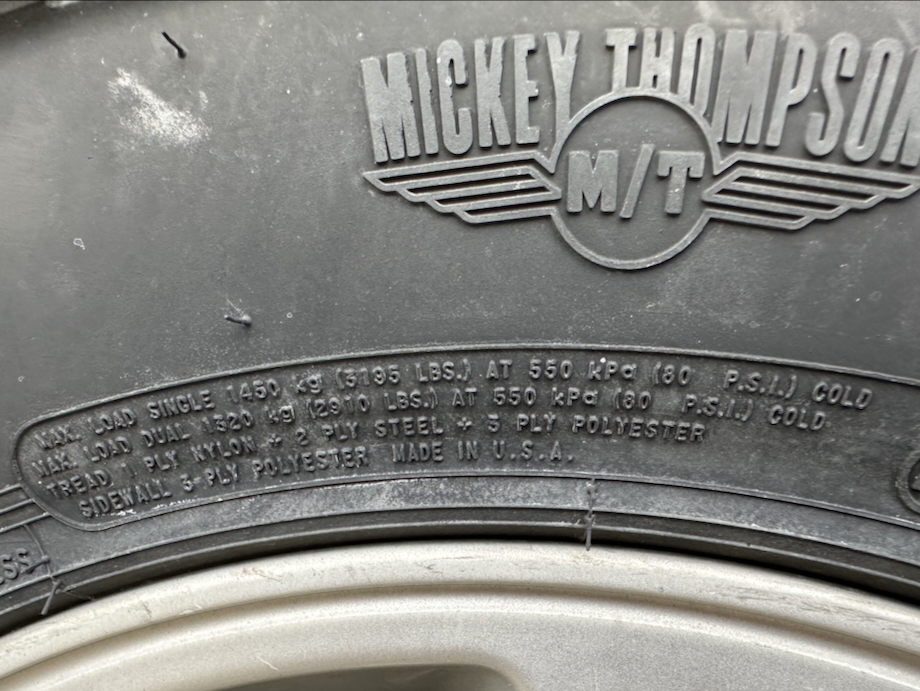
Tyre side wall
Max PSI 80
Max load 1450 kg
Tyre PSI Factor = (80/1450) = 0.05517
Unhitched
Front Axle Load: 1644 kg
Rear axle load: 1860 kg
Hitched
Front Axle load: 1575 kg
Rear Axle Load: 2179 kg
Lets do the math
Unhitched
Front Axle recommended PSI = 0.05517 x (1644/2)=822 = 45 PSI
Rear Axle recommended PSI = 0.05517 x 930 = 51 PSI
Hitched
Front Axle recommended PSI = 0.05517 x 788 = 43 PSI
Rear Axle recommended PSI = 0.05517 X 1090 = 60 PSI
In this example you’ll notice that the front axle pressures drop by 2 PSI and the rear increase by 9 PSI unhitched versus hitched.
Calculations versus Passenger Comfort
When it comes to the tow vehicle, driver and passenger comfort is also a consideration. If the rear tyres were 51 PSI unhitched and 60 PSI hitched, it’s likely to be a harsh ride for the occupants. So this is were the 4 PSI or 6-7 PSI rule can be used. If you do a Google/Bing search or ask an AI agent the question about what is the right tyre pressure the results will likely include one of these. Some call it a rule I think of it more as a guide.
The guide says that from cold pressure after an hour of driving (not stop start traffic) your tyre PSI should increase by the 4 or 6-7 PSI, whichever one you pick. When you check your tyre pressure, if the increase is less then your tyre pressure is too high. If it is more then your tyre pressure is too low.
I personally follow the 6 PSI guide which provides a bit more passenger comfort. So when I’m not towing front is 38 PSI and rear is 42 PSI. This means that when tyres are hot the front will be 44 PSI and rear will be 48 PSI. When towing the fronts start cold at 38 PSI and the rear start at 46 PSI so the requisite 6 PSI increase means the fronts will be 44 PSI and the rears will be 52 PSI.
Key takeaways
- correct tyre pressures are important on the tow vehicle and the trailer/caravan
- tyre pressures vary with load, weights, suspension, vehicle geometry and each individual setup; especially the tow vehicle
- passenger comfort needs to be considered
- the right tyre pressures for you, your passengers and your setup is more art than science
calculation formula: recommended tyre pressure = (Max PSI / Max load) x current tyre load
4 or 6-7 PSI Guide: measured difference in tyre pressure from cold to hot pressures
